
.
Here God Lives Among People
It is a rare and often undervalued privilege to live in a diocese where cathedral building is a present activity.
For well over a century we had routinely and lovingly maintained a magnificent Cathedral established by our Catholic ancestors. But now in our own era parishioners and friends of the Catholic Diocese of Christchurch have a graced opportunity to join generations past as Cathedral builders.
This is an undertaking which our ancestors welcomed as a favourable time of diocesan unification, a call to stand tall as Catholics in the region, deepening foundations of faith with a renewed impetus to extend open arms of mission.
For our Catholic ancestors Cathedral building was more a process than a project. It was a concrete exercise of personal and communal growth in and expression of faith in Jesus Christ.
Now that the Cathedral of the Blessed Sacrament build has been launched it is helpful to invite a deeper contemplation and consideration of a question which might seem at first odd.
Are we building our new Cathedral in heaven or on earth?
Our Catholic ancestors appreciated this question as a primary consideration.
For them a House of God, while constructed on a plot of earth was in fact more a sanctuary of heaven, a point at the heart of a diocese where heaven and earth could meet.
Our Celtic ancestors understood that there were some natural places across a landscape where it seemed easy to connect with God, sites which they knew to be thin places – where the veil was lifted between the human and the divine and where God and humans could touch.
A Cathedral is such a place. A Cathedral touches the soul.
As Monsignor James Harrington reflected in his homily at the centenary Mass for the Cathedral of the Blessed Sacrament in 2005:
What then is the secret of the Cathedral? Its secret is to be found in the text from sacred scripture carved in foot-high letters across the façade Ecce Tabernaculum dei cum Hominibus. Freely translated: ‘Behold! Here God lives among people.’ For us this Cathedral is a living home, a place enriched with God’s presence. Its very mass bears witness to the sacred amid the secular, the eternal amid the ever-dying present. Like the great cathedrals of Europe this building proclaims the primacy of the spiritual and the kingdom we must seek above all else.
Therefore the one who enters the Cathedral is no longer simply on earth but has crossed a threshold into a narthex of heaven, a place where interaction with the divine, both communal and personal, is the desire and the occupation. A haven where human potential is recognised and encouraged and where the failures of men and women are embraced as a personal capacity for and experience of divine presence and action.
This is why a Catholic Church is not simply blessed or dedicated on opening day but consecrated with the Oil of Chrism, the oil otherwise reserved for sacramental anointings in the three sacraments which impart to humans a permanent and distinctive character: Baptism, Confirmation and Holy Orders.
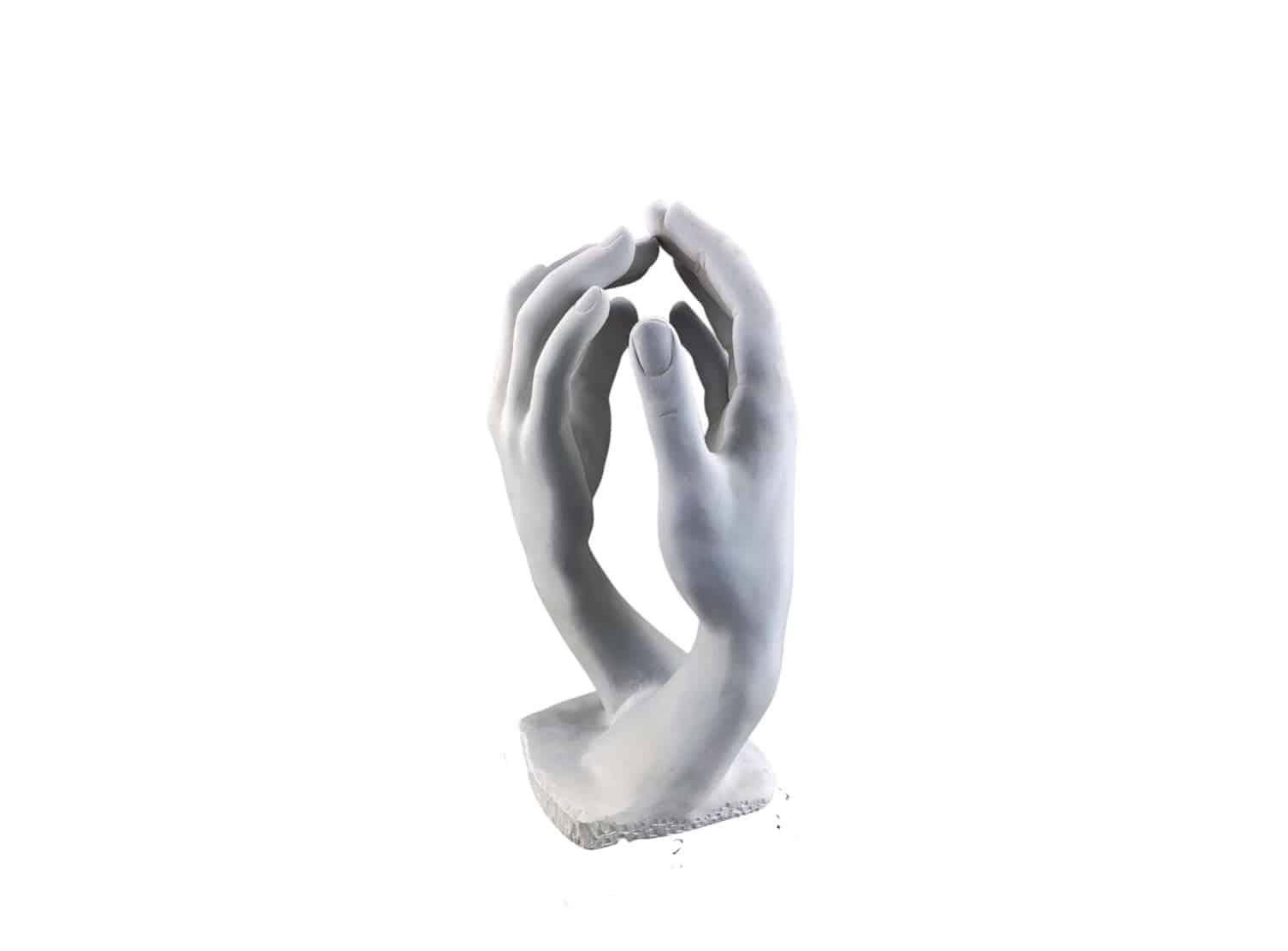
As Christchurch was building the Cathedral of the Blessed Sacrament in the early 1900’s, French artist Auguste Rodin sculpted The Cathedral pictured above.
It’s a surprising work, not arches and apses with windows and columns but two human hands, the right hands of two individuals, imitating gothic (reaching for God) elevations of generations past.
As Rodin reflected at the time:
“A cathedral is built on the principle of living bodies. Its concordances, its equilibrium, exactly follow general laws according to nature’s order”. Rodin understood a Cathedral even more as a living body than as a physical structure, echoing St. Paul speaking of the Church as the body of Christ, the people of God living in harmony, pondering and praying, with and through human joys, hopes, griefs and anxieties.
As Antoni Gaudi (d.1926) the holy architect of the famous Sagrada Familia in Barcelona and nicknamed God’s architect wrote, a Cathedral is a work that is in the hands of God and the will of the people.
The rare privilege of cathedral building is celebrated in art, in literature, and even in popular historical fiction.
Ken Follett’s well known The Pillars of the Earth (1994) is a captivating communication of the mindset behind the often competitive Cathedral building enterprises of the Middle Ages.
One of the protagonists in Follett’s tale, stonemason Tom Builder, appreciates the community-building potential of a great Cathedral project. His employer Abbot Philip oversees the project with Christ-centred leadership commenting that my first priority would be to build the church and smarten up the services. That comes before food!
Each year on the feast of the dedication of the pope’s Cathedral in Rome, St. John Lateran, an Office of Readings text for the feast is taken from the writings of sixth-century bishop Caesarius of Arles. He writes
And if we think more carefully about the meaning of our salvation, we shall realise that we are indeed living and true temples of God. God does not dwell only in structures fashioned by human hands, in homes of wood and stone, but rather he dwells principally in the soul made according to his own image and fashioned by his own hand. Therefore, the apostle Paul says: The temple of God is holy, and you are that temple.
The process of Cathedral-building is a commitment to the heart of faith, relationship with Jesus Christ who is God with us, a call for every sister and brother, parishioner and citizen to walk arm in arm and work hand to hand ensuring that every aspect of the building of the church is fine-tuned, love of God in love of family, friend and foe, justice for those in need, liberty for those who are captive and oppressed.
As we will pray in the Collect for the Mass of Dedication of our new Cathedral of the Blessed Sacrament:
From this place may the whole world
clothed in the dignity of the Children of God
enter with gladness
God’s city of peace.

A. very valuable and insightful reflection which enhances the depth of meaning behind the building process itself. Thank you Fr John
A graced opportunity to grow synodality from the grassroots up. May the team privileged to work closely on this construction pay close attention to your spiritual wisdom spoken here.
I’ve just finished reading the short book(let), A Seed is Sown, written for the centenary of the Rangiora-Oxford Catholic parish, and one aspect of the church building that was appreciated was it’s harmony with both the natural world and human society in the surrounding areas. This Cathedral looks like it seeks a ‘harmony’ with its surroundings and community. Great use of space and light. Hopefully we will bring back the use of bells, and ensure that all the senses are engaged as we draw close to the temple of God.
Cathedral: the location seat for the Divine with the Human; the Incarnation of past and present activating vitality for The Now.
I admire J. O’C’s linking of the old with the new in the Ecce Tabernaculum, highlighted suring the Centenary by Mons Harrinton, a lover of the Cathedral of The Blessed Sacrament and dedicated Aministrator there for so many years.
A piece of writing worth remeditating upon. Thank you. Kia Kaha, Christchurch.
Great reflection on the Cathedral- any chance of getting into wider media e.g The Press
The Good News Jesus speaks of is about making a preferential option for the poor. Throughout Aotearoa many of our brothers and sisters and their kids go hungry while others are homeless. Let’s unite and build a cathedral of love that shelters the birds of the air instead.
A beautiful thought “to walk arm in arm” as we grow our relationship with Jesus Christ,
who is our God. Whatever we are doing!!